
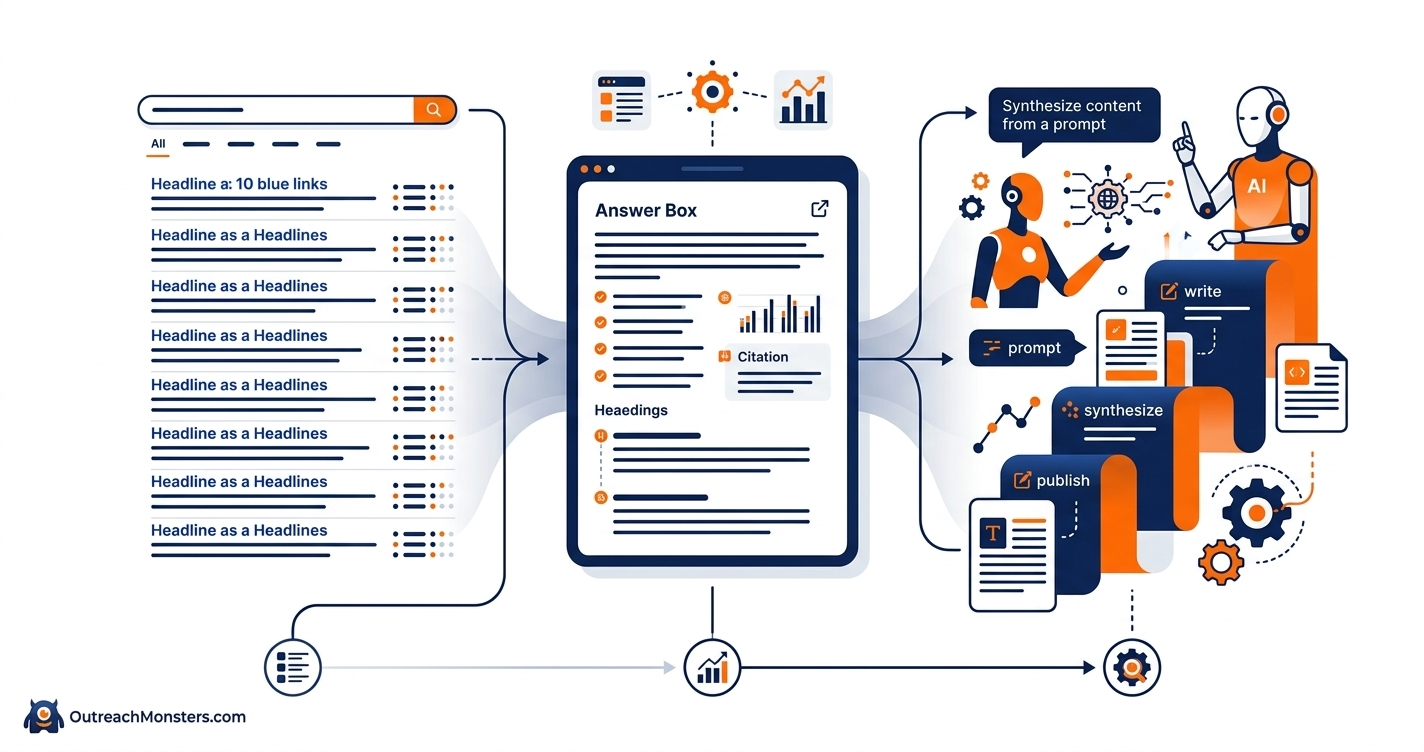
SEO, or Search Engine Optimization, is all about getting your pages to rank higher on Google and Bing. Then there’s AEO, which stands for Answer Engine Optimization. This technique helps structure your content so it can be picked as the direct answer in featured snippets, voice search results, and Google AI Overviews. And let’s not forget GEO, or Generative Engine Optimization, which positions your brand to be recognized as a reliable source in AI-generated responses from platforms like ChatGPT, Perplexity, and Gemini. These three strategies work hand in hand, all rewarding the same essential investment: building authoritative backlinks.
Here’s a staggering statistic: over 60% of Google searches now end without a single click. Users are getting their answers right on the results page, skipping the website visit altogether. On top of that, 68% of B2B decision-makers have already moved the initial stage of their research from Google to AI tools like ChatGPT and Perplexity.
What this means is that the search landscape you optimized for just three years ago looks almost unrecognizable today. If you’re still relying solely on an SEO playbook, you’re missing out on huge opportunities for visibility, and potential customers.
That’s where AEO and GEO come into play. These two strategies have emerged alongside AI-driven search to fill this gap. Together with SEO, they create a three layer visibility framework that encompasses traditional search rankings, direct AI answers, and generative citations. In this guide, you’ll find a straightforward breakdown of what each term means, how they differ, and, most importantly, how you can develop a strategy that seamlessly integrates all three without having to start from scratch.
Let’s kick things off with the foundation that every digital marketer is already familiar with.
What exactly is SEO, or Search Engine Optimization?
SEO is all about enhancing your website so it ranks higher in organic search results on platforms like Google, Bing, and YouTube. When someone enters a query into a search engine and clicks on a blue link, SEO is the art and science that decides which link pops up first.
At its Heart, SEO Revolves Around Three Main Pillars
On-Page SEO
This includes the keywords you choose, how you structure your headings, the quality of your content, and the internal links that tie your pages together. On-page signals help search engines understand what your page is about and who it’s meant for.
Off-Page SEO (backlinks)
These are the links that lead to your domain from other websites. Backlinks serve as endorsements, the more reputable the linking site, the stronger the vote of confidence. This remains the most significant authority signal in organic search.
Technical SEO
This covers aspects like site speed, mobile responsiveness, Core Web Vitals, crawlability, and indexation. If search engines can’t easily access and comprehend your content, then the on-page and off-page signals won’t hold much weight.
Here’s something crucial to grasp before diving into AEO or GEO: SEO is the bedrock upon which both of these disciplines are built. You can’t optimize for AI responses if your pages aren’t crawlable, authoritative, and trustworthy. Without a solid SEO foundation, adding AEO and GEO strategies on top will yield minimal results.
Think of SEO as the framework. AEO and GEO are the additional floors you construct on top of it.
“SEO gets you in the game. Without it, there is no game for AEO or GEO.”
So, no, SEO isn’t dead. It’s evolving. By 2026, its role has transformed from being the sole search discipline to becoming the essential prerequisite for every other discipline that follows.
What exactly is AEO, or Answer Engine Optimization?
AEO is all about crafting your content in a way that it gets picked as the direct answer, rather than just landing somewhere near the top of search results. It focuses on those situations where search engines don’t just send users to a webpage; instead, they read the answer aloud or showcase it prominently before any clickable link shows up.
So, what are these situations? They include:
- Featured snippets That highlighted text box you see above the organic results on Google for certain queries.
- Voice Search Results The single answer that Siri, Alexa, or Google Assistant reads out loud when you ask a question.
- Google AI Overviews Those AI-generated summaries that pop up at the top of some Google results pages, pulling together answers from various sources.
- Position Zero The highly sought-after spot right above the top organic result, reserved for the page that Google deems the most direct answer to a query.
The implications here are pretty significant. In the world of AEO, you’re not just aiming to rank for a keyword; you’re striving to be the chosen answer to a specific question. This shift in focus completely transforms how you write and organize your content.
“SEO gets you on the menu. AEO makes you the recommended dish.”
To excel at AEO, your content needs to adhere to a particular format. Start every relevant page or section with a clear, direct answer of about 40–60 words before diving into more detail. Frame your headings as real questions that your audience is likely to search for. Plus, make sure to use FAQ schema and structured data so search engines can easily extract and display your answers in a format they can read.
One last thing to keep in mind: AEO isn’t just about being brief. The pages that consistently snag featured snippets and voice search results are also authoritative, well-linked, and comprehensive. A short answer on a low-authority page won’t outshine a concise answer on a high-authority domain. That’s why SEO, especially your backlink profile, remains crucial even in this context.
For a full breakdown of what AEO means in practice If you want to dive deep into what AEO really means and the specific strategies that can help you snag those coveted featured snippets, check out our comprehensive guide.
What is GEO (Generative Engine Optimization)?
Now, let’s talk about GEO, or Generative Engine Optimization. This is the latest addition to the trio of optimization strategies, and it tackles a whole new type of search experience. GEO is all about getting your brand, content, or data referenced in AI-generated answers, those multi-paragraph, multi-source responses that platforms like ChatGPT, Perplexity, Google Gemini, and Claude create when users pose complex questions.
Here’s the crucial difference from AEO that you should really grasp:
On the other hand, GEO is about being the source of that answer. So, if someone asks ChatGPT, “what’s the best link-building strategy for a B2B SaaS company?” you want your agency’s content to be one of the references included in the response, even if the user never actually visits your website. That’s the essence of GEO.
Measuring GEO can be trickier than AEO or SEO. Unlike traditional search rankings or featured snippet victories, AI citations can change rapidly, differ based on how users phrase their queries, and are still not well-tracked by most analytics tools. By 2026, platforms like Profound are starting to develop “share of AI voice” metrics, but this area is still in its infancy.
Despite the challenges, pursuing GEO is definitely worthwhile. Brands that get mentioned in AI-generated answers are cultivating brand awareness and trust, even among users who don’t click through to their sites. As AI-driven research becomes the norm for younger professionals, being present in those synthesized answers might just be more important than landing on the first page of Google.
What does GEO content really look like? Well, it’s typically deep, authoritative, and original. Generative AI tools tend to lean towards sources that share proprietary data, reference credible third-party research, include quotes from named experts, and show clear signs of authority. When it comes to topical depth, it’s a big deal, an AI engine is much more likely to reference a site that has published fifteen in-depth articles on a topic rather than just one standout piece.
And let’s not forget about backlinks. Generative AI tools don’t work in a vacuum; they’re influenced by the web’s trust framework. They prefer to cite sources that are widely recognized online, and the best indicator of that recognition, according to every ranking system out there, is a strong inbound link profile.
A Quick Look At The Three Disciplines:
Aim to rank higher on Google and Bing. Boost clicks through keyword authority, backlinks, and technical performance. This is the essential foundation.
Google · Bing · YouTube
Get chosen as the direct answer before the blue links. This targets featured snippets, voice search, and Google AI Overviews with content that prioritizes answers.
Siri · Alexa · Google AIO
Aim to be cited as a trusted source in AI-generated answers. Gain brand mentions in ChatGPT, Perplexity, and Gemini, even without a click.
ChatGPT · Perplexity · Gemini
AEO vs SEO vs GEO: side-by-side comparison
Now that you’ve got a grasp on what each discipline does on its own, it’s time to see how they compare across the key dimensions. The table below outlines every major variable, from success metrics to the importance of backlinks, so you can quickly identify where each approach fits into your current strategy.
Take a close look at the “role of backlinks” row. It highlights a crucial signal that connects all the dots.
| Dimension | SEO | AEO | GEO |
|---|---|---|---|
| Full name | Search Engine Optimization | Answer Engine Optimization | Generative Engine Optimization |
| Primary goal | Win keyword rankings and drive organic traffic | Be selected as the direct answer, Position Zero | Be cited as a trusted source in AI-generated answers |
| Target platforms | Google, Bing, YouTube | Voice assistants, Google AI Overviews, featured snippets | ChatGPT, Perplexity, Gemini, Claude |
| Success metric | Rankings, organic traffic, CTR, conversions | Featured snippet capture rate, voice result wins | Brand citations in AI answers, share of AI voice |
| Content format | Long-form articles, product pages, pillar content | 40–60 word direct answers, FAQ schema, Q&A headers | Deep authoritative guides, original data, expert quotes |
| Key ranking signals | Backlinks, technical SEO, on-page keywords | Answer-first structure, schema markup, concise language | Domain authority, E-E-A-T, topical depth, backlink profile |
| Role of backlinks | Core ranking factor, the #1 authority signal | Important, high-DA domains are cited more in snippets | Critical, AI engines preferentially cite high-authority sources |
| Traffic outcome | High direct click-through traffic | Lower CTR, answers delivered on SERP | Often zero-click, brand visibility and mindshare |
| Measurement tools | Google Search Console, Ahrefs, SEMrush, Moz | SERP tracking, snippet monitoring tools | Profound, Share of AI Voice tools (emerging in 2026) |
| Difficulty level | Established, mature playbook | Moderate, clear tactics, newer field | High, moving target, limited data signals |
So, which one should you prioritize?
This is the million-dollar question every marketer grapples with, and the answer often leaves people wanting a straightforward, one-size-fits-all solution you actually need all three, but in the right order..
The silver lining is that this order makes sense, and the initial steps set the stage for greater returns down the line. Here’s the game plan:
Start With a Solid SEO Foundation
Before diving into AEO or GEO, you need a technically sound and authoritative website. This means addressing crawl issues, establishing a consistent backlink profile, creating in-depth content on your main topics, and achieving a solid baseline domain authority. Without this groundwork, no amount of answer-first formatting or schema markup will help you snag featured snippets, and AI engines won’t see you as a reliable source.
Add AEO to Your Existing SEO Content
Once you’ve built up your domain authority and rankings, revisit your highest-traffic, most-queried pages and incorporate AEO best practices. Start by adding a 40–60 word direct answer at the top of each article. Rework your subheadings into genuine questions. Implement FAQ schema on pages that have Q&A sections. You’ll often find that small structural tweaks to content that’s already ranking can quickly unlock featured snippet opportunities.
Unlock GEO by Diving Deep into Data & Establishing Your Topical Authority.
GEO naturally evolves from a solid foundation of AEO and SEO. As you enhance your topical depth, thoroughly exploring your subject through a network of interconnected articles, and as your backlink profile expands, generative AI tools begin to reference your content as a valuable resource. You can speed up this process by sharing original research and unique data: think statistics, surveys, and case studies that others don’t have, which AI tools actively look for as credible sources.
It’s time to completely rethink how you approach these three areas. Instead of asking, “Which one should I focus on?” shift your mindset to “How can I integrate all three into a cohesive organic visibility strategy?” The brands that will create eight times more discovery touchpoints in 2026 aren’t picking between SEO, AEO, and GEO; they’re viewing them as a unified, synergistic system.
And at every level of this system, there’s one investment that pays off across the board: building authoritative, high-quality backlinks.
The importance of link building across all three areas
Here’s a perspective that many agencies overlook, and it’s crucial for your bottom line as you juggle SEO, AEO, and GEO together.
Backlinks are the key signal that connects all three areas.They aren’t just an SEO concern; they’re essential for AEO and relevant for GEO as well. Let’s break down how they work in each context.
Backlinks Boost Domain Authority & Rankings.
Both domain authority and page authority, heavily influenced by the number and quality of your inbound links, are the best indicators of where you’ll rank organically. A site boasting 200 high-quality backlinks from reputable, authoritative domains will consistently outperform a technically flawless site with just 12 backlinks from low-authority sources.
High-DA Pages Are More Likely to Snag Featured Snippets
When Google picks a featured snippet, it hardly ever goes for a page from a low-authority domain, even if that page has the most straightforward answer. Authority signals, like backlinks, serve as a filter for selection. Having an answer-first format is just the beginning; it’s your backlink profile that really gets you in the door. Without that authority, your well-structured content might sit at position 8, missing out on the coveted Position Zero.
AI Engines Favor Authoritative Sources
Generative AI tools don’t have real-time analytics or audience insights at their fingertips. Instead, they gauge trustworthiness based on signals embedded in the web’s structure, and the most dependable of these signals is inbound links from recognized domains. A source that boasts backlinks from Forbes, Harvard Business Review, and leading industry publications is seen as authoritative in ways that a site with few links simply can’t match.
This is why backlinks are the top trust signal for AI search across all fields, not just traditional SEO. And it’s why the smartest investment you can make in your organic visibility strategy for 2026 and beyond is to systematically build a collection of high-quality, authoritative inbound links from relevant domains.
At OutreachMonsters, this is exactly what we do for our clients. We focus on earning links from authoritative, topically relevant sources, the kind of links that signal trustworthiness to Google’s ranking algorithm, to the featured snippet selector, and to the AI tools that pull together answers from the most credible parts of the web. If you want your brand to shine across all three visibility arenas, it all starts with your link profile.
Conclusion: Stop Choosing & Start Integrating
By now, it should be pretty clear. SEO, AEO, and GEO aren’t just three separate strategies you need to pick from, they’re actually three interconnected layers of a single organic visibility framework, each one building on the last.
SEO lays the groundwork: authority, crawlability, and rankings. AEO takes that foundation and expands it into direct answers, capturing visibility in a landscape where over 60% of searches end without a click. GEO goes even further, securing your brand a spot in AI-generated answers that a whole generation of researchers now considers their starting point.
And at the core of all three disciplines, driving each one, is the same essential element: a robust, authoritative, and qualitative backlink profile. Without it, your AEO content won’t get chosen. Your GEO content won’t get referenced. Your SEO rankings won’t stick.
The brands that will thrive in 2026 aren’t just picking between SEO, AEO, and GEO. They’re weaving all three together, beginning with the authority that every system values.