- 1. Quick Answer: Mentions vs Backlinks
- 2. What Is an Unlinked Brand Mention?
- 3. What Is a DoFollow Backlink?
- 4. Detailed Side-by-Side Comparison
- 5. What the 2025 & 2026 Research Says
- 6. Do Unlinked Mentions Help Google SEO?
- 7. ChatGPT & Perplexity Visibility
- 8. The Best Combined Strategy
- 9. How to Measure Mentions & AI Visibility
- 10. Frequently Asked Questions
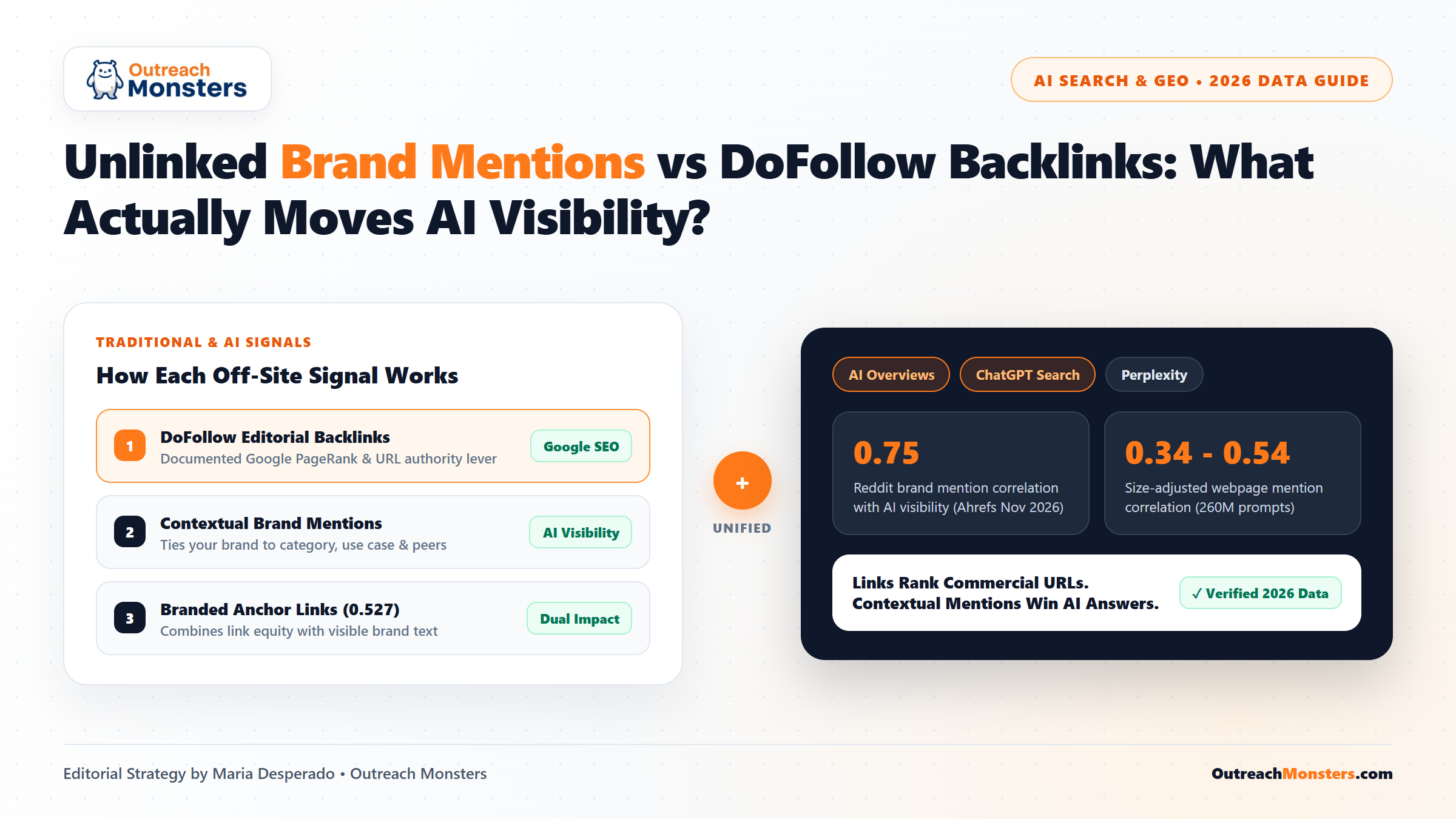
Spearman correlation between Reddit brand mentions and AI visibility in Ahrefs' Nov 2026 study (260M prompts).
Webpage mention correlation after controlling for brand size bands (down from 0.70 overall).
Domain Rating correlation with ChatGPT mentions (0.266) vs Google AI Overviews (0.326).
Here is a situation that happens more often than most teams expect. A B2B SaaS company has spent two years on link building. It has editorial links from respected marketing publications, a healthy referring-domain count and a Domain Rating its competitors envy. Then the head of marketing asks ChatGPT for "the best tools for [their category]," and the brand isn't there. A smaller competitor with a fraction of the links gets named in almost every answer.
The usual explanation is that AI search "doesn't care about backlinks anymore." That's too simple, and it leads teams to the wrong decisions. The better question is narrower: when you compare brand mentions vs backlinks for SEO and AI visibility, which signal does which job, and how much of the popular research actually separates the two?
This guide looks at what the data measures, what Google has said on the record, what OpenAI and Perplexity document about their search products, and where the honest answer is still "we don't know." If you need the wider context first, our guide to AEO vs SEO vs GEO covers how traditional and generative search fit together.
Quick Answer: Brand Mentions vs DoFollow Backlinks
A DoFollow backlink is a normal, crawlable hyperlink with no rel="nofollow", "sponsored" or "ugc" attribute. Google documents links as an input to its link analysis systems, including PageRank. An unlinked brand mention is your brand name in text on another site with no hyperlink. Google has said it does not treat those mentions as links.
For AI visibility, the picture flips. Large Ahrefs studies find that how often a brand is named across the web, on YouTube and in Reddit threads correlates much more strongly with AI mentions than backlink counts do. Those are correlations, not proof that mentions cause AI recommendations.
The practical answer: links remain the stronger documented lever for Google rankings, and frequent, contextual third-party mentions track more closely with AI visibility. Most brands need both, measured as separate outcomes.
What Is an Unlinked Brand Mention?
An unlinked brand mention is any reference to your company, product or founder on a third-party page that doesn't include a clickable link to your site. Some SEOs call these "linkless backlinks" or "implied links." Neither term is a Google term, and both suggest more than the evidence shows.
Unlinked mentions turn up in predictable places. A trade publication quotes your CEO but links only to its own author page. A news story covers your funding round. A comparison article lists you as "also worth considering" without a link. A Reddit thread recommends your product, or a podcast host names you and the transcript gets indexed.
Take a realistic example. A logistics newsletter writes: "Teams that outgrow spreadsheets usually move to tools like ShipLane or FreightDesk (hypothetical examples), and ShipLane's route-cost reports are the main reason operations managers pick it." There's no link. Even so, that sentence ties ShipLane to a category (logistics software), a buyer (operations managers), a use case (route-cost reporting) and a competitor (FreightDesk).
That context matters more than the mention count. A mention is only as useful as four things:
- Relevance: is the publication read by your buyers, and is the article about your category?
- Source quality: is it independent editorial content or a page anyone can pay to appear on?
- Context: does the sentence say what you do, and for whom?
- Accuracy: are your positioning, pricing tier and features described correctly?
An inaccurate mention can do quiet damage. If ten articles describe you as "an enterprise tool" after you've moved down-market, that's the description models and readers will repeat.
What Is a DoFollow Backlink?
A DoFollow backlink is a standard hyperlink from another site to yours that carries no link qualifier. "DoFollow" is industry shorthand, not an HTML attribute. There is no rel="dofollow". A link is simply "followed" unless the publisher adds rel="nofollow", rel="sponsored" or rel="ugc".
Google's documentation is explicit about why links matter to it. Its guide to ranking systems lists "link analysis systems and PageRank" among the systems in use, and describes PageRank as a core system that has changed a great deal since launch. Its spam policies state that Google uses links as a factor in determining the relevancy of pages.
Link equity (the informal name for the value a link passes) is not a fixed quantity. A link from a relevant, well-linked, indexed page on a trusted site is a very different asset from a footer link on a scraped directory. Treat any claim that "one DR 70 link equals X" as marketing, not measurement.
Backlinks usually arrive through a few routes:
- Editorial backlinks earned because a writer chose to cite your data, tool or expert.
- Guest contributions where you write for a publication and reference your own resources where relevant.
- Link insertions that add a contextual link to an existing, already-indexed article.
- Digital PR campaigns built around original research, which journalists link to as the source.
DoFollow vs Nofollow vs Sponsored vs UGC
Google's guidance on qualifying outbound links asks publishers to mark paid placements with rel="sponsored", user-generated links such as comments and forum posts with rel="ugc", and other links they don't want to vouch for with rel="nofollow".
One detail many link buyers miss: since September 10, 2019, Google has treated all three attributes as hints rather than strict instructions for ranking, and nofollow became a crawling and indexing hint on March 1, 2020. In the same post, Google said it would generally keep treating such links as before and not consider them for ranking. So a nofollow link is not worthless (it still sends readers, still names you in visible text, and Google may use it in some cases), but you shouldn't price it like an editorial followed link.
Four Outcomes Teams Often Confuse
Most confusion in this debate comes from mixing up four different results. They're related, but one doesn't guarantee another.
| Outcome | What it means | Example | How you'd check it |
|---|---|---|---|
| Brand mention in an AI answer | The model names your brand in its response | ChatGPT lists you among "best CRM tools for startups" | Prompt tracking, manual testing |
| Source citation | A page is shown as a linked source for the answer | Perplexity cites an industry review as source [3] | Citation reports, referral traffic |
| Editorial backlink | Another site links to yours in its content | A trade outlet links to your pricing study | Backlink tools, Search Console Links report |
| Entity recognition | Search systems understand your brand as a distinct "thing" with attributes | Google shows a knowledge panel for your company | Branded SERP checks, knowledge panel presence |
The gaps between these are where strategy gets interesting. A comparison article can be cited by Perplexity without your brand being mentioned in the generated answer. Your brand can be named by ChatGPT while the cited sources are someone else's pages. And your site can earn a strong editorial link from a page that no AI tool ever retrieves.
Brand Mentions vs DoFollow Backlinks: Detailed Comparison
Neither format wins across the board. The table shows what each one is documented or observed to do, and where the evidence is thin.
| Dimension | Unlinked brand mentions | DoFollow backlinks |
|---|---|---|
| Traditional SEO value | Indirect at best. Google says no signal passes without a link | Direct. Links feed Google's link analysis systems |
| Google ranking implications | Can lead to branded searches and later links; not a confirmed ranking factor | Documented ranking input; manipulative links violate spam policies |
| AI search visibility (overall) | Strong correlation in large studies (about 0.66 to 0.75 depending on mention type) | Weak correlation (backlinks 0.218, referring domains 0.295 for AI Overviews) |
| ChatGPT | Correlations present but weaker than on Google surfaces | DR correlates 0.266 with ChatGPT brand mentions |
| Perplexity | Live retrieval with numbered citations, so the page must be found and fetched | Matters if links help a page rank and get retrieved |
| Google AI Overviews / AI Mode | Strongest observed mention correlations; Google says normal SEO applies | Indirect: only 38% of AIO citations rank top 10, but ranking still helps |
| Referral traffic | None from the mention itself | Yes, if the page has readers |
| Brand awareness | Yes, especially in respected publications | Yes, but awareness comes from the content, not the link |
| Entity associations | Text ties the brand to a category, use case and competitors | Anchor text and surrounding copy do the same job |
| Editorial credibility | High when independent; low when paid or self-published | Same rule applies |
| Link equity | None | Variable, never fixed |
| Measurability | Harder: mention tools match text, not meaning | Easier: mature backlink indexes and Search Console |
| Acquisition methods | PR, expert commentary, reviews, listicles, podcasts, communities | Editorial outreach, guest posts, link insertions, research |
| Long-term value | Compounds if the description is accurate and repeated | Compounds while the linking page stays live and indexed |
Two cautions about reading this table. First, platform outcomes differ, so "AI visibility" is never one number. Second, the strong AI correlations come from studies that count every mention of a brand name, linked or not. We'll unpack why that matters in the next section.
What Does the Research Actually Say?
The short version: brands that are talked about widely tend to appear in AI answers more often, and backlink counts track that much less closely. The longer version has caveats that change how you should act on it.
| Study | Sample | Key figures (Spearman) | What it can't prove |
|---|---|---|---|
| Ahrefs: AI Overview brand visibility factors (May 26, 2025) | 75,000 brands, DR 40+, Google AI Overviews only | Web mentions 0.664; branded anchors 0.527; branded search 0.392; DR 0.326; referring domains 0.295; backlinks 0.218 | Causation; other AI platforms |
| Ahrefs: brand visibility in ChatGPT, AI Mode and AI Overviews (Dec 12, 2025) | Same 75,000 brands, three platforms | YouTube mentions ~0.737; web mentions 0.66 to 0.71; DR 0.266 (ChatGPT), 0.285 (AI Mode); site pages ~0.194 | Whether metrics are drivers or markers of brand strength |
| Ahrefs: which mention types correlate with AI visibility (Nov 3, 2026) | 10,000 US brands, 260M non-branded prompts | Reddit 0.75; webpage mentions 0.70; news 0.67; YouTube 0.64; TikTok 0.60; ChatGPT mostly 0.60 to 0.65 | Causation; matches exact names, not entities |
| Ahrefs (Patrick Stox): brand bias across assistants (July 2025) | Top 50 sites per assistant | Web mentions vs AI visibility: AI Overviews 0.65; Perplexity 0.3; ChatGPT 0.15 | Generalizing beyond the top 50 |
| Ahrefs: AI Overview citations and the top 10 (March 2026) | 863K keywords, 4M cited URLs | 38% of cited pages rank top 10 for the query (76% in July 2025); about 31% sit outside the top 100 | Why pages get cited |
What the 75,000-brand studies show
The first study found that the three strongest correlates of AI Overview mentions were all off-site brand signals. Brands in the top quarter for web mentions had a median of 169 AI Overview mentions, against 14 for the next quarter down. About 26% of the sample had no AI Overview mentions at all and was excluded from the correlations.
The December follow-up extended the work to ChatGPT and AI Mode and added YouTube data. YouTube mentions (a brand named in a video title, description or transcript) came out on top at roughly 0.737. Domain Rating stayed weak on every platform.
Why the November 2026 study matters more than the headlines
The newest Ahrefs study is the most useful for this debate because it tests the obvious objection: maybe big brands get mentioned everywhere, including in AI answers, and the mentions themselves do nothing.
Ahrefs split brands into size bands by branded search volume. Within each band, the correlation between webpage mentions and AI mentions fell from 0.70 to between 0.34 and 0.54. So brand size explains a large share of the relationship, but not all of it. Among brands of similar popularity, the ones mentioned more often still tended to show up in AI answers more often.
The study also found the effect is smaller on ChatGPT. A brand with 10x more webpage mentions received about 3.5x more AI Overview mentions but about 2.2x more ChatGPT mentions. And 46% of brands had zero ChatGPT mentions, compared with 18% on AI Overviews.
The detail most summaries miss
Ahrefs defines branded web mentions as mentions of the brand name anywhere across the web. That count includes pages that also link to you. The study did not isolate unlinked mentions, and the November study says outright that it doesn't report linked versus unlinked figures.
That changes the reading. The headline compares how often your name appears on the web (0.664) with how many links point at you (0.218). It is not a test of "a mention without a link" against "a link without a mention." Notice too that branded anchors (links whose anchor text is your brand name) scored 0.527, more than twice the raw backlink count. A link that carries your name in visible text looks a lot more like the signal AI systems track than a link hidden behind "click here."
Correlation, not causation
Ahrefs makes this point itself in every one of these studies. The December report notes the factors may be markers of existing brand strength rather than direct drivers. A company that launches a popular product earns press, YouTube reviews, Reddit threads, links and AI mentions at once. Any of those could be the cause, or all of them could be effects of the product.
Our read: the evidence supports investing in being discussed, in context, across independent sources. It doesn't support the claim that buying unlinked mentions will make ChatGPT recommend you.
Do Unlinked Brand Mentions Help Google Rankings?
Not directly, as far as Google has said publicly. When asked in a 2022 office-hours session whether Google treats unlinked brand mentions like links, John Mueller answered that there is no link, so there is no signal passing. In 2020 he gave a similar answer about unlinked citations: they usually don't help rankings directly, though they can help people discover a site. Even Ahrefs' own content director, quoted in its 75,000-brand study, said unlinked mentions have very little impact on SEO.
You'll still read that Google "confirmed" brand mentions in a patent. The patent usually cited, "Ranking search results," does describe "implied links" as references that aren't express hyperlinks. But Search Engine Journal's analysis of that patent reads the implied links as being calculated largely from branded and navigational search queries. And a patent shows what Google explored, not what it runs today. We'd treat it as a historical curiosity, not a strategy.
Where mentions can still help, indirectly
The indirect routes are plausible and, in some cases, documented:
- Discovery and future links. A journalist who reads about you in one outlet is more likely to cite and link to you in the next. Many strong editorial links start as unlinked mentions.
- Branded demand. Coverage that makes people search your name creates branded queries and clicks. This is a reasonable hypothesis about why mentions might help over time, not a confirmed mechanism.
- Reputation as quality raters see it. Google's Search Quality Rater Guidelines tell raters to research a site's reputation through independent sources such as news articles and reviews. Raters don't set rankings, but their ratings are used to evaluate Google's systems. Independent coverage is the kind of evidence those guidelines reward.
- Entity understanding. Google says knowledge panel information comes from various sources across the web, and that its Knowledge Graph is built from web content plus licensed data. Consistent descriptions across independent sources make it easier for any system to understand what your brand is.
Why mentions aren't a substitute for backlinks
If your goal is ranking a specific commercial page, an unlinked mention can't point authority at that page. It names the brand, not the URL. A followed link from a relevant article to your pricing or category page does something a mention can't. For Google rankings, keep the distinction clear: established evidence supports links; the case for mentions rests on indirect effects and informed hypotheses.
Do Brand Mentions Help ChatGPT and Perplexity Visibility?
Probably, but through retrieval and repetition rather than any "mention score." Neither OpenAI nor Perplexity publishes ranking factors for which brands get recommended, so anything more specific is inference.
Here is what is documented. OpenAI's publisher FAQ says any public website can appear in ChatGPT search, and that sites must not block OAI-SearchBot if they want their content in ChatGPT's summaries and snippets. ChatGPT also adds utm_source=chatgpt.com to referral links. Perplexity's help center says it searches the web in real time and that each answer includes numbered citations to its sources. Google says AI Overviews and AI Mode may use query fan-out, running several related searches across subtopics, and that no special optimization is required beyond normal Search eligibility.
Why third-party pages carry so much weight
When these tools search the web for "best project management software for agencies," they retrieve pages, then write an answer from what those pages say. Your own homepage says you're great. A review site, a comparison article or a Reddit thread says who you're good for, compared with whom. That second kind of text is exactly what a recommendation answer is made of. (Our guide on getting featured in best-of listicles covers that format in detail.)
So the mention that matters is usually inside a page that gets retrieved. That's why a mention can matter for AI search without a link: the model reads the text, not the link attribute. It's also why a mention on a page no AI tool ever fetches may do very little.
Consistency is an underrated factor
One professional observation, not a documented ranking factor: models summarize what sources agree on. If six independent articles describe you as "payroll software for US restaurants," an answer engine has an easy, repeated description to work with. If those articles describe you six different ways, it has less to go on. Consistent positioning across independent sources is something you can influence through briefing journalists, updating review profiles and correcting outdated descriptions.
Platforms behave differently
The data suggests Google's AI surfaces lean harder on brand prevalence than ChatGPT does. Patrick Stox found web mentions correlated 0.65 with visibility in AI Overviews, 0.3 in Perplexity and only 0.15 in ChatGPT, within the top 50 sites for each. The November 2026 Ahrefs study shows the same direction with a much larger sample. A strategy tuned only to AI Overviews may underperform in ChatGPT.
And a mention never guarantees a recommendation. Being listed in an article that ChatGPT retrieves is a precondition, not an outcome. If you want the tactical side, our guide on how to get cited in ChatGPT walks through prompt sets and tracking.
Does a DoFollow Backlink Matter More Than an Unlinked Mention?
It depends on what the placement is supposed to achieve. Asking "link or mention?" in the abstract is like asking whether a billboard beats a sales call. The surrounding context often matters as much as the link attribute. Six common scenarios show how that plays out.
| Scenario | Likely value for Google rankings | Likely value for AI visibility | Our take |
|---|---|---|---|
| Editorial followed link from a relevant industry publication | High | Moderate to high if the article describes you in context | The best case: both jobs in one placement |
| Unlinked mention in a highly authoritative national publication | Low, directly | Potentially high if the page is retrieved | Worth pursuing; ask for a link later only if it fits naturally |
| Followed link from an irrelevant, low-quality site | Low, and risky if it looks manipulative | Close to none | Skip it, whatever the DR |
| Brand named in a respected, maintained comparison article | Low to moderate | High for commercial prompts | Often the most efficient placement for AI search |
| Link on a page with no traffic that isn't indexed | Little to none | None | A link Google can't index can't help |
| Mention on a source AI tools frequently cite (a ranking Reddit thread, a widely referenced review site) | Low, directly | High, based on the Reddit correlation data | Earn these honestly; spam gets removed and remembered |
Three insights from doing this work
These are reasoned professional views, not proven algorithmic factors.
1. A contextual unlinked mention in your niche can beat an irrelevant followed link. A trade publication sentence like "most mid-size fleets use X for route costing" gives readers, journalists and answer engines a precise association. A followed link from a general "business tips" blog gives Google a weak link-graph signal and gives everyone else nothing. If you could only have one, the niche mention is usually the better asset, unless the specific job is ranking one URL.
2. Measure link acquisition and brand recognition as separate outcomes. Most link-building reports count referring domains and stop there. That hides the question an executive now asks: "Are we showing up in AI answers?" One placement can score well on one outcome and zero on the other. Track both columns for every campaign, and you'll quickly see which publishers do double duty.
3. Repetition across independent publications builds the footprint. One great article is a data point. Ten independent sources describing you the same way is a pattern. The Ahrefs quartile data, where the top quarter of brands had far more AI mentions than the rest, fits this view. Visibility in AI answers looks less like a single big win and more like accumulated agreement across the web.
Build both contextual brand mentions and DoFollow backlinks in one place
Stop guessing which placements actually move Google rankings and AI answers. Filter 6,100+ vetted, real-traffic publications by DR, organic traffic, country, and placement format (Guest Post, Link Insertion, Niche Edit, and Listicle) with zero PBNs.
The Best Strategy: Build Both Brand Mentions and Backlinks
The strongest off-site programs treat links and mentions as two outputs of the same work: being worth writing about, then making it easy for the right publications to write about you. How you weight the mix depends on the goal.
| Business goal | Lean toward | Tactics that fit |
|---|---|---|
| Rank specific commercial pages in Google | Followed editorial links | Contextual guest contributions, link insertions in relevant indexed articles, resource-led outreach |
| Appear in AI answers for category prompts | Contextual third-party mentions | Comparison and best-of articles, reviews, expert commentary, community participation |
| Build authority in a new category | Both, via original research | Data studies, surveys and benchmarks that journalists cite and link |
| Fix a weak or inaccurate brand description | Consistent mentions | Briefing writers, updating review profiles, correcting old articles |
A few tactics deserve more detail:
- Digital PR and expert commentary. Journalist requests and expert quotes produce mentions reliably and links sometimes. Pitch a specific point of view or number, not a bio.
- Original research and statistics. This is the one tactic that consistently earns both. A useful number gets cited by writers, and many of them link to the source.
- Guest contributions and link insertions. Best for links to specific URLs. Choose publications your buyers read, and insist the placement sits in relevant, indexed content.
- SaaS comparison pages, reviews and listicles. Often the shortest path into AI answers for commercial prompts, because these pages are written in the language of recommendations.
- Community participation. Reddit and niche forums matter, but only as a genuine contributor. Promotional posting gets removed and can damage how the brand is described.
- Thought leadership. Podcasts, YouTube interviews and conference talks create transcripts that name your brand, which fits the YouTube correlation data.
If you'd rather not build publisher relationships from scratch, Outreach Monsters runs editorial placements across a vetted publisher network, filterable by niche, traffic and country. The same rule applies there as anywhere: relevance first, metrics second.
How to Measure Brand Mentions and AI Visibility
No single tool measures everything here, and no tool sees every ChatGPT conversation. Build a small scorecard instead, and be clear about what each metric can and can't tell you.
| Metric | Tool or method | What it tells you | What it can't tell you |
|---|---|---|---|
| New referring domains and followed links | Ahrefs, Semrush, Search Console Links report | Link acquisition and link-graph growth | Whether those links affect AI answers |
| Unlinked mentions | Ahrefs Content Explorer, Brand Radar, other brand monitoring tools | Where your name appears without a link (outreach targets) | Meaning: most tools match text, not entities |
| Branded search demand | Google Search Console, Google Trends, keyword tools | Whether coverage creates search interest | Why demand changed |
| AI share of voice | AI visibility trackers (Ahrefs Brand Radar, Semrush and others) | Mention rate across a sampled prompt set | Real user conversations, which no tool sees |
| Manual prompt tests | A fixed list of 20 to 30 buyer prompts, rerun monthly | How answers describe you and competitors | Statistical significance; answers vary run to run |
| AI referral traffic | GA4 referral reports (ChatGPT tags utm_source=chatgpt.com) | Visits and conversions from AI tools | Mentions that never produce a click |
Two practical habits help. First, keep your prompt list stable for at least a quarter so trends mean something. Second, log every placement with both a link column and a "described accurately?" column. That second column is where most AI visibility problems show up first.
Common Mistakes Businesses Make
Most of these come from treating one metric as the whole story.
- Chasing backlink quantity over relevance. Fifty links from unrelated blogs add risk and little else. Ten links from publications your buyers read can move rankings and perception.
- Ignoring unlinked coverage. Teams often discard mentions because "there's no link." Those pages are both outreach targets and potential AI sources.
- Paying for meaningless mentions. A brand name dropped into a thin, low-traffic article is unlikely to be retrieved by anyone, human or machine. Paid editorial placements also need disclosure; paid links should carry rel="sponsored" under Google's policies.
- Treating Domain Rating as the only quality metric. DR correlates weakly with AI visibility (0.266 to 0.326 across platforms). Topical relevance, real traffic and indexation matter as much.
- Assuming every AI citation is a backlink. A source citation in Perplexity links the cited page, not necessarily you. A brand mention in ChatGPT may have no citation at all.
- Confusing correlation with causation. Brands with lots of mentions may be visible in AI answers because they are popular, not because of the mentions.
- Expecting immediate results. AI answers change as sources and models change. One placement rarely moves a mention rate; patterns across months do.
Frequently Asked Questions
Are unlinked brand mentions good for SEO?
They help indirectly. Google has said unlinked mentions don't pass link signals, so they aren't a confirmed ranking factor. They can still drive discovery, branded searches and future editorial links, and they correlate strongly with AI visibility.
Are brand mentions better than backlinks for AI visibility?
In large Ahrefs studies, brand mention counts correlate far more strongly with AI mentions than backlink counts (0.664 vs 0.218 for AI Overviews). Those mention counts include linked pages, and correlation doesn't prove cause, so the safest conclusion is that being widely discussed matters more than raw link volume.
Does Google count unlinked brand mentions?
Not as links. John Mueller has said that with no link, no signal passes. Google may still read the text on a page that names you, and its knowledge panels draw on information from across the web, but Google hasn't documented mentions as a ranking signal.
Do nofollow backlinks help SEO?
Sometimes, a little. Since 2019 Google treats nofollow, sponsored and ugc as hints rather than strict rules, though it said it would generally not use such links for ranking. They still send referral traffic and put your brand in visible text that AI tools can read.
Do ChatGPT and Perplexity recognize unlinked brand mentions?
They read page text, so a mention on a page they retrieve can shape an answer whether or not it's linked. Perplexity documents real-time search with numbered citations, and OpenAI documents OAI-SearchBot for ChatGPT search. Neither publishes how brands are selected for recommendations.
Should businesses prioritize backlinks or digital PR?
Match it to the goal. If you need specific pages to rank in Google, prioritize relevant editorial links. If you're invisible in AI answers for category prompts, prioritize coverage in comparison articles, reviews and industry press. Original research is the overlap that tends to earn both.
How can I track unlinked brand mentions?
Use a brand monitoring or content index tool, such as Ahrefs Content Explorer or Brand Radar, plus Google Alerts for basic coverage. Review results manually, because most tools match exact text and can't tell your brand from a common word with the same name.
Conclusion: Stop Treating Mentions and Links as Opposing Strategies
The debate over brand mentions vs backlinks for SEO is mostly a measurement problem. Backlinks remain the documented way to send authority to a page Google ranks. Contextual brand mentions, repeated across independent sources people actually read, track much more closely with whether AI tools name you. The research doesn't say one replaced the other. It says they do different jobs, and that a link with your brand name in visible text does a bit of both.
So stop reporting on links alone. Plan placements for both outcomes, judge every publication on relevance before metrics, keep your brand description consistent, and track rankings and AI share of voice side by side.
If you want help building that mix, Outreach Monsters works on both sides: editorial backlinks through guest posts and link insertions, and AI brand mentions in the comparison articles and industry publications that answer engines read. We can't promise any tool will recommend you. We can help make sure the right sources describe you accurately.
Ready to earn editorial backlinks and AI brand mentions together?
Whether you run an SEO agency or manage organic growth in-house, Outreach Monsters gives you direct access to 6,100+ vetted publications and high-ranking comparison listicles with transparent pricing and live 5-stage order tracking.
Sources & Research References
- Which Types of Mentions Correlate the Strongest With AI Visibility? (260M AI Prompts Analyzed) (Ahrefs, Nov 3, 2026)
- Update: 38% of AI Overview Citations Pull From The Top 10 (Ahrefs, March 2026)
- Top Brand Visibility Factors in ChatGPT, AI Mode, and AI Overviews (75k Brands Studied) (Ahrefs, Dec 12, 2025)
- Google Seems More Biased Towards Big Brands Than ChatGPT and Perplexity (Ahrefs (Patrick Stox), July 2025)
- An Analysis of AI Overview Brand Visibility Factors (75K Brands Studied) (Ahrefs, May 26, 2025)
- Qualify your outbound links to Google (Google Search Central, Current)
- Evolving "nofollow": new ways to identify the nature of links (Google Search Central, Sep 10, 2019)
- A guide to Google Search ranking systems (Google Search Central, Current)
- Spam policies for Google web search (Google Search Central, Current)
- AI features and your website (Google Search Central, Current)
- About knowledge panels (Google, Current)
- Search Quality Rater Guidelines: An Overview (Google, Nov 2023)
- Publishers and Developers FAQ (OpenAI, Current)
- How does Perplexity work? (Perplexity, Current)
- Does Google Treat Unlinked Mentions Like Links? (Search Engine Journal, Apr 5, 2022)
- Google: Unlinked Citations Usually Do Not Help With Search Rankings (Search Engine Roundtable, May 21, 2020)
- Google's branded search patent for ranking search results (Search Engine Journal, Not stated)
- Changes to HowTo and FAQ rich results (Google Search Central, Aug 2023)