- 1. Why AI skips brands that rank on Google
- 2. What citation studies actually show
- 3. ChatGPT Search vs Google AI Overviews
- 4. The 5 step playbook to earn citations
- 5. Why page one listicles move the needle fastest
- 6. Writing passages AI models actually quote
- 7. How to track AI citations without guessing
- 8. Frequently asked questions
Here's something worth doing before you read any further. Go to ChatGPT, type in "top 3 agencies" or "best tools" for whatever your niche is, and look at what comes back.
A lot of the time you'll see a company you beat on Google. Sometimes two of them.
And you won't be there.
We started getting this question constantly last year. How do we get cited in ChatGPT, and in Google's AI Overviews? Usually from founders and agency owners who'd done exactly that test and didn't like the answer. So if you landed here wondering how to get cited in ChatGPT, you're asking the same thing half our inbox is asking.
Google still sends the leads, sure. Nobody's saying stop doing SEO. But buyers have picked up a new habit. They ask an AI for a shortlist first and click around after, if they click at all.
We already wrote a longer piece on AEO vs SEO vs GEO, so I'll skip the theory here. This post is the practical bit. What makes these AI tools pick one brand over another, what the bigger studies found, and how we actually run outreach for clients using the publishers in our network. Most of it is a lot less mysterious than LinkedIn makes it sound.
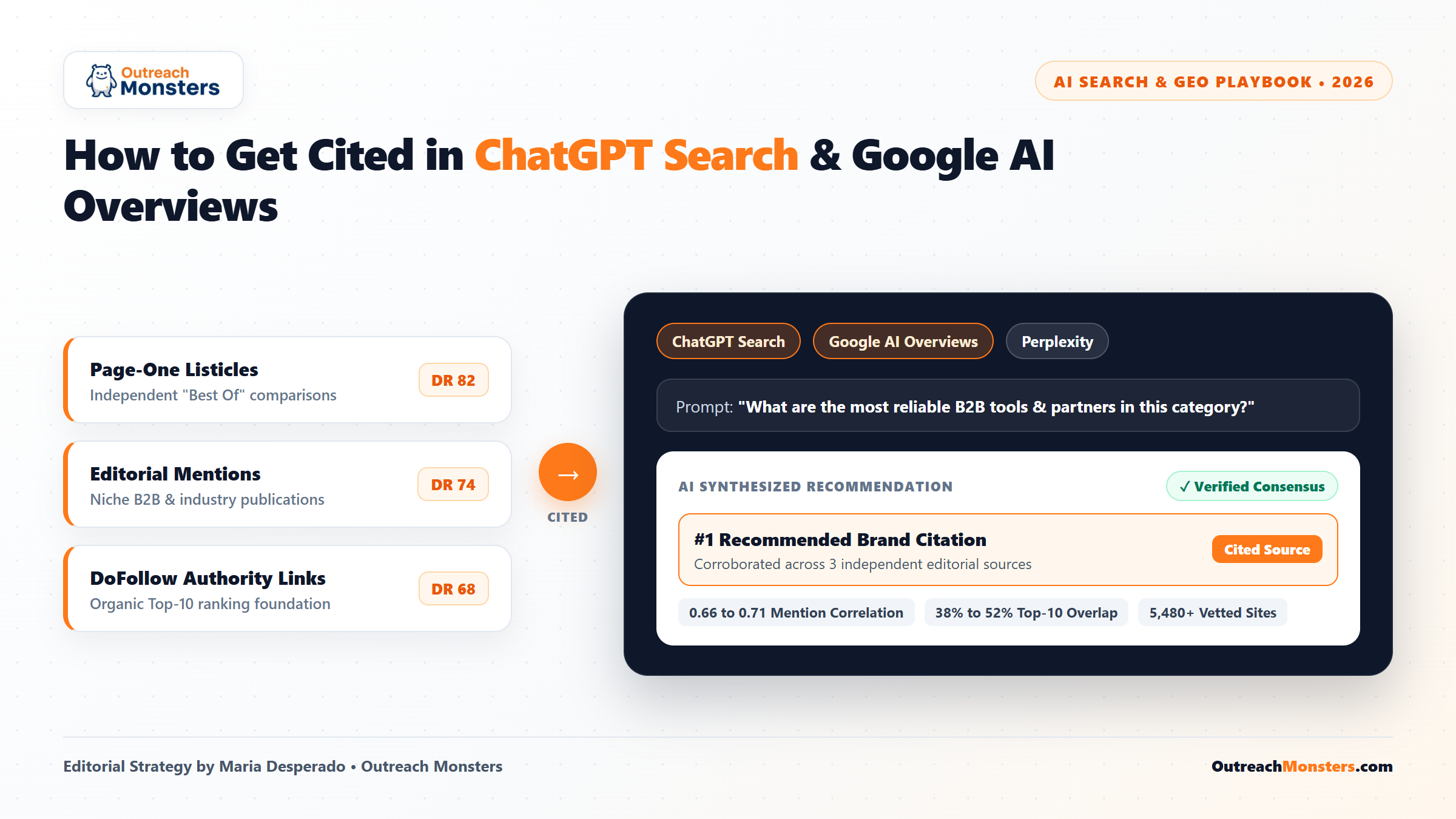
That's the correlation Ahrefs found between brand mentions across the open web and how visible a brand is in ChatGPT. They looked at 75,000 brands to get there.
Roughly this many of the URLs Google AI Overviews cite already rank in the normal top 10 for that same search.
Share of AI Overviews that use a list or a comparison layout when someone asks a commercial question.
1. Why AI skips brands that already rank on Google
In house SEO folks bring this one to us a lot. They're #3 for the money keyword, the site is technically fine, the landing page is genuinely good. They've done everything the checklist says.
ChatGPT still acts like they don't exist.
Annoying, but there's a reason. Your site saying you're the best doesn't count for much, because every site says that. Best CRM. Most trusted accounting firm in North America. Everybody's homepage reads like that. An AI tool building a list of vendors, whether that's ChatGPT Search or Gemini, wants to see someone else back you up. Someone who isn't you.
So your homepage is basically your pitch. The proof lives on other sites: industry blogs, comparison posts, review pages. Get three or four of those describing you the same way, in the same category, and the model is comfortable putting you in its answer. Without them it has no real reason to, and it would rather leave you out than risk a bad recommendation.
2. What recent citation studies actually show
You've probably seen the LinkedIn posts. One secret prompt. One schema tag nobody's using. Honestly, most of that is guesswork dressed up as strategy.
The big independent studies are less exciting to read but way more useful. Here's what they actually found.
- Branded web mentions beat raw domain size in ChatGPT: Ahrefs went through 75,000 brands. Mentions of a brand across the open web had a 0.66 to 0.71 correlation with how often it showed up in AI answers. YouTube mentions were even stronger at 0.737. Now look at Domain Rating by itself: only 0.266 in ChatGPT (and 0.326 in Google AI Overviews). Total number of pages on the site? 0.194. Keep in mind that correlation is not causation, as bigger brands tend to earn both more mentions and more AI visibility, but a high DR alone rarely buys you AI recommendations if nobody is talking about you.
- Google AI Overviews still lean on the organic top 10: Ahrefs, Surfer and seoClarity all looked at this and landed somewhere around 38% to 52% of cited URLs coming from pages already in the top 10. Being number one gives you the best odds. Once you fall below position five, those odds drop fast. Not great news if you've been stuck at #7 for a year.
- Query fan out lets pages outside the top 10 in: The other half of citations come from pages that don't rank top 10 for the main keyword at all. That's because Google takes a complicated question and quietly breaks it into smaller ones. Then it grabs whatever passage answers each little piece best. A page sitting at #23 for the big term can still win one of those smaller questions.
- Formatting influences selection: Surfer's data showed lists, numbered or bulleted, in more than 78% of AI Overviews. And short answers that make sense on their own, around 130 to 170 words, get lifted way more easily than long rambling paragraphs. Which is kind of funny, since that's also what human readers prefer.
3. ChatGPT Search vs Google AI Overviews: Side by side
Marketers tend to throw both of these into one bucket called Generative Engine Optimization, or GEO. Makes sense on paper. In practice ChatGPT Search and Google AI Overviews find their sources differently, and if you plan for them like they're the same thing you'll end up paying for placements that help one and do nothing for the other. Here's the quick version.
| Factor | ChatGPT Search | Google AI Overviews |
|---|---|---|
| Primary Retrieval Source | The live web, mostly. Third party listicles, editorial reviews, community threads. | Google's own organic index. Plus fan out into related sub topics. |
| Response Style | Acts like someone helping you shortlist. Names actual brands, often with pros, cons and who each one suits. | Sums up the topic first. Citation cards get attached inline or off to the side. |
| Biggest Visibility Lever | Showing up again and again in independent "best of" posts, niche blogs and comparison guides. | Ranking top 10, with good editorial backlinks and passages that are cleanly formatted. |
| Role of Your Own Site | Mainly a fact check. It confirms your pricing and features once other sites have vouched for you. | Can get cited directly, if your page answers a sub question clearly and has decent link authority. |
| How Fast Changes Appear | Often 2 to 4 weeks after the new placement or updated listicle gets indexed. | Usually 2 to 6 weeks, depending on when Google recrawls the updated listicle or new page. |
Map Buyer Prompts
Find the real comparison questions buyers type into ChatGPT and Google.
Audit Cited URLs
List the page one listicles and niche articles those answers already pull from.
Earn Editorial Mentions
Get your brand mentioned, with dofollow links, inside those same publications.
Reinforce On Page Facts
Fix your product pages and FAQs so AI tools can double check what you do.
4. The 5 step playbook to get cited in ChatGPT and AI Overviews
No one can tell you which trick works next quarter. Anyone who says they can is selling something.
What we can tell you is which steps keep showing up in the client campaigns we're running right now. There are five.
Build a list of 20 commercial prompts your buyers actually ask
Don't bother with textbook stuff like "what is accounting software." No one's pulling out a credit card after that search. Go for prompts people type when they're close to buying. Things like "best white label link building provider for agencies," "top payroll tools for US startups," or "alternatives to [Main Competitor]." Run each one in ChatGPT Search, Perplexity and Google. Write down every site that gets cited. A plain spreadsheet is fine, nothing fancy.
Export the third party listicles that mention your competitors
This part goes quicker than you'd think. Within about twenty minutes you'll see the same 10 to 15 comparison articles and industry blogs popping up again and again, even when you word the prompt differently. Then count. If your competitors are on eight of those pages and you're on zero, well, there it is. That's the gap. That's why ChatGPT keeps naming them and not you.
Earn placements inside existing page one comparison articles
Asking an editor to add you to a comparison guide that already ranks is so much faster than writing a new post and waiting months for it to climb. Once you're in an established article, with a clear line on what you do, some pricing context and a natural link, Google and ChatGPT both pick it up the next time they crawl the page. This is pretty much the whole idea behind our AI Brand Mentions and GEO service. We built it around this one workflow.
Keep building real editorial links to your core money pages
Go back to that 38% to 52% number for a second. Top 10 pages make up a big share of what AI Overviews cite. So if your comparison pages and service pages are sitting on page three, Google isn't going to trust them enough to quote them. The fix isn't exciting. Keep getting real links. Regular editorial guest posts and contextual link insertions on sites that actually get traffic. That's what moves your own URLs into the group of pages Google will pull from.
State who you serve and what you do in plain language
AI tools have no idea what to do with a tagline like "reimagining next gen synergy." Buyers don't either, if we're being honest. Go through your About page, pricing page, author bios and any profiles you have on other sites. They should all say the same plain facts. What category you're in. Who your customers are. Your main features. Where you work. When all of that lines up everywhere, the model can describe you correctly without having to guess.
Skip the cold pitching guesswork on page one listicles
Cold emailing 200 editors to get into their listicle sounds fine until you actually do it. Reply rates in the single digits, then weeks of follow ups. Our live AI Brand Mentions Catalog skips that part. It lists real comparison articles and vetted industry publications where our editorial team already knows the people in charge. You can check organic traffic, DR and turnaround time for each one before you order anything.
5. Why page one listicles move the needle faster than anything else
Picture someone asking ChatGPT for the "best B2B SaaS link building agencies." The model isn't going to trust one agency's sales page for that. Of course the sales page says they're the best.
So it goes and finds pages that already compare a bunch of vendors next to each other. Listicles, basically.
A decent third party roundup does three useful things for an AI tool, all at the same time:
- Category association: Your brand name shows up right beside the service keyword and the kind of buyer you work with.
- Peer grouping: If you're listed next to well known names in your industry, the model figures you belong in that same group.
- Contextual pros: Editors normally add a line or two on what makes each brand different. Transparent pricing, maybe. White label reports. A niche you focus on. ChatGPT often repeats those exact points, in its own words, when it recommends you. So what the editor writes about you kind of becomes your AI pitch.
It's why agencies with lots of client domains have started doing both at once. Regular white label link building on one side, targeted brand mentions on the other. The links help the client climb in Google. The listicle spots get the client named in ChatGPT and Perplexity. And you can run both in the same 90 day sprint, which makes the client report look a lot better too.
6. Writing on page passages that AI models actually quote
Getting links and mentions off site gets your page into the running. Whether a paragraph on that page actually gets quoted is a different question, and that comes down to how clear it is.
You don't need to write like a machine. Just remember people skim. AI retrieval skims too, in a pretty similar way.
- Answer the question right under the heading: If an H2 or H3 is a question, answer it straight away in the first sentence or two. Save the nuance and examples for after.
- Use small comparison tables: A simple HTML table comparing prices, timelines or options is one of the easiest things for Google AI Overviews and Perplexity to read. Less chance they get the details wrong.
- Use real numbers and stuff you've seen firsthand: Generic advice gets ignored. A thousand blogs already said it. But specific benchmarks, the actual criteria you use to vet something, things you noticed during a campaign? That gives the model a concrete reason to credit your page.
- Add clean FAQ and Organization schema: JSON LD alone won't get you cited, and nobody should promise that. What it does is remove confusion about your brand name, who wrote the content, and what your main answers are.
7. How to track AI citations without guessing
Tracking this stuff is still a bit of a mess, to be honest. Google Search Console mixes AI Overview clicks in with normal search data, so you can't separate them. And ChatGPT referral traffic only shows people who clicked. It misses everyone who read your name in the answer and then searched for you later on their own.
So we keep it simple. This is the monthly routine we'd suggest, and it works whether you're a brand or an agency:
- Keep one sheet with the same 20 prompts: Once a month, run those exact 20 buying questions in ChatGPT Search, Perplexity and Google AI Overviews. Use a fresh incognito window every time.
- Score where you show up: Are you in the answer at all? Are you top three? Which third party pages got cited as the source? Write it all down.
- Watch branded searches and direct signups: In Google Search Console, filter for your brand name across 90 days. If branded impressions go up around the same time new listicle placements go live, that's a pretty good sign the AI visibility is turning into actual demand.
- Add "How did you hear about us?" to your lead forms: More B2B demo requests than you'd expect now type "ChatGPT" or "Perplexity" in there. Even when analytics says the visit came from Direct or Organic Search.
Combine vetted backlinks and AI brand mentions in one workspace
Running an SEO agency with 30 client sites? Or handling organic growth for one B2B brand? Either way, you can filter 5,480+ vetted publications in our Publisher Marketplace by DR, real organic traffic, country and turnaround time. Each order goes through a five stage tracker you can see, and payment is held until you approve the live placement. New here? The Platform User Guide walks you through all of it.
8. Frequently Asked Questions
How do I get my brand cited in ChatGPT Search?
Get mentioned in the third party comparison articles, industry roundups and trusted niche blogs that already sit on page one for the keywords your buyers use. ChatGPT Search looks at the live web. Before it recommends anyone, it wants to see several trusted sites agreeing about them.
Does ranking on page one of Google help you appear in Google AI Overviews?
Yes, quite a lot. Studies from Ahrefs, Surfer and seoClarity found roughly 38% to 52% of URLs cited in AI Overviews already rank in the organic top 10. Good rankings backed by real editorial backlinks are still the best place to start.
Why does ChatGPT recommend my competitors instead of my brand?
Usually it's simple. They show up on more outside sites than you do. They're in the well known "best of" lists, review roundups and niche publications. So the AI has proof from other people about what they do and who they do it for. With you, it only has your word.
Are unlinked brand mentions enough, or do I still need backlinks?
Do both if you can. That's where the biggest lift comes from. Brand mentions track closely with ChatGPT visibility. Dofollow editorial backlinks build the authority that keeps your pages in Google's top 10, which is also the pool AI Overviews pick from. For the full data breakdown, see our guide on brand mentions vs backlinks.
How long does it take to see brand citations after a GEO outreach campaign?
ChatGPT Search and Google AI Overviews read live, indexed pages. They don't need to wait for a model to be retrained. So once you land on a page one listicle that's indexed, it can start affecting AI answers in about 2 to 6 weeks.