- 1. How Perplexity finds and cites sources
- 2. Why best-of listicles carry so much weight
- 3. What makes a listicle placement valuable
- 4. A placement scorecard you can use
- 5. Step-by-step process to get featured
- 6. Misconceptions and mistakes that waste budget
- 7. How to measure whether placements work
- 8. Frequently asked questions
Ask Perplexity which white-label link building services suit a small agency, then look at the numbered citations under the answer. Many of them point to roundups: "best link building services," "top white-label SEO providers" and pages like them. The brands named in those roundups are the ones the answer can draw on.
That's the case for trying to get featured in best-of listicles. When an AI engine searches the web to answer a "best X for Y" question, it doesn't evaluate every vendor itself. It retrieves pages where someone has already compared the options, then summarizes them. If your brand is missing from those pages, it's missing from the material the answer is built from, and your AI search visibility suffers for it.
What follows: how Perplexity picks its sources, what the citation research shows and where it's weak, how to judge a placement, a step-by-step process for earning one, and how to measure the result. If you're also comparing broader AI search frameworks, read our guides on AEO vs SEO vs GEO and how to get cited in ChatGPT Search and Google AI Overviews.
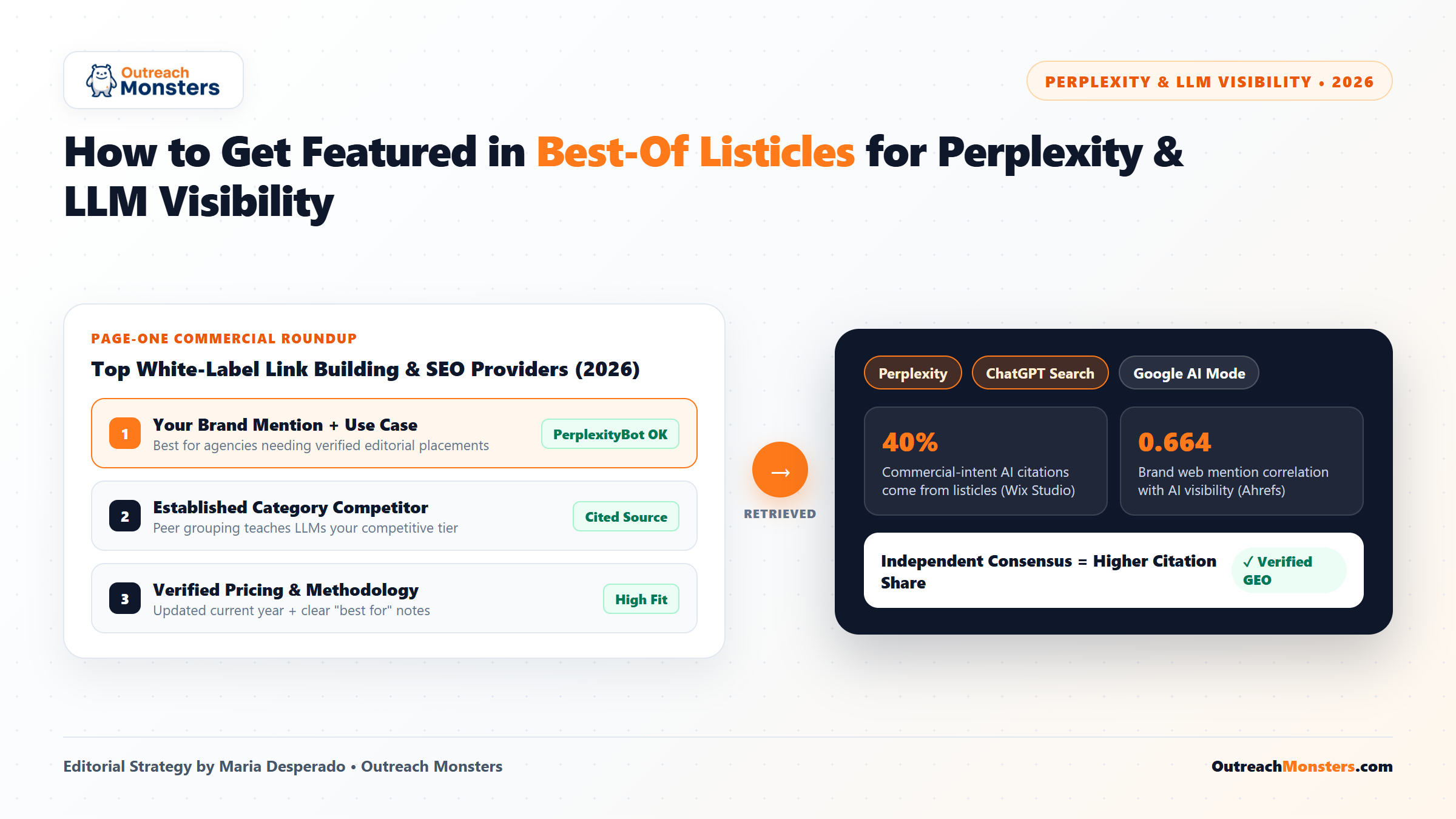
Share of commercial-intent AI citations coming from listicles in Wix Studio's 75,000-answer study (21.9% overall).
Correlation between brand web mentions and Google AI Overview visibility in Ahrefs' 75,000-brand study (vs. 0.218 for backlinks).
Share of URLs reaching Perplexity's high-citation bucket in Peec's analysis of over one million citations.
1. How Perplexity finds and cites sources
Perplexity is a retrieval-first engine. According to its help center, it searches the web in real time for each question and attaches numbered citations that link to the original sources. The language model writes the answer, but the search step decides what the model gets to read.
Perplexity hasn't published how it ranks or chooses among the pages it retrieves. Beyond that retrieve-then-cite process, everything here, including this article's advice, comes from outside research and testing, not official documentation.
That's why the search step deserves most of your attention. A brand can only appear in a Perplexity answer if a retrieved page mentions it. For a question like "best link building agencies for SaaS," the agencies' own homepages are rarely those pages. Comparison articles, review sites, Reddit threads and industry roundups usually are.
What PerplexityBot needs from a page
Perplexity builds its index with its own crawler. Its crawler documentation says PerplexityBot exists to surface and link websites in Perplexity search results, and that it is not used to train foundation models. Perplexity also states that PerplexityBot respects robots.txt.
This has a practical consequence. A placement on a site that blocks PerplexityBot may still help your Google rankings, but Perplexity won't index the page's full text; its support article says it may still keep the domain, headline and a brief factual summary. Before you invest in a listicle, open the publisher's /robots.txt and check. Dark Visitors reports that about 12% of top websites block PerplexityBot.
Perplexity is picky, and it spreads its bets
Perplexity cites several sources per answer, but very few pages earn repeated citations. Peec's analysis of over a million citations found that only about 6% of URLs reach Perplexity's high-citation tier, and described the engine as highly selective. Wix Studio's research adds that roughly 40% of Perplexity citations come from discussions, more than double other models.
So listicles are a major input for Perplexity, but forums and community threads carry real weight too. A brand that appears in three strong roundups and is also discussed positively on Reddit gives the engine several independent sources that agree. Our working assumption, and the basis of the process below, is that this kind of agreement beats Perplexity brand mentions on any single page. Perplexity doesn't publish its selection factors, so treat that as strategy rather than documented fact.
2. Why best-of listicles carry so much weight in AI answers
A listicle is shaped like the question. Someone asks "what's the best X for Y," and a roundup has already gathered the options, compared them and labeled who each one suits. For a retrieval system, few pages are more convenient. One URL supplies a dozen candidate brands, a short description of each and a reason to pick one over another.
The research on citations backs this up, though each study has limits worth knowing before you quote it to a client:
| Study | Engines covered | Finding | Caveat |
|---|---|---|---|
| Wix Studio AI Search Lab, 75,000 answers | ChatGPT, Google AI Mode, Perplexity | Listicles were 21.9% of all citations and 40% of commercial-intent citations | Intent, not model, best predicted what got cited |
| Evertune, 25,000 URLs | Six engines incl. Perplexity | Listicles were 40 to 65% of each model's most-cited URLs | Sponsored content; no Perplexity-only figure |
| The HOTH, 4 brands | ChatGPT only | Brand's own site cited in 69.6% of brand-name answers but 1.3% of "best" answers | Small sample; vendor that sells placements |
| Ahrefs, 75,000 brands | Google AI Overviews | Brand web mentions correlated at 0.664; backlinks at 0.218 | Correlation, not causation |
| Peec on GPT-5.6, Aug 2026 | ChatGPT | Listicles fell from 15.47% to 8.19% of retrieved pages; product pages rose | Single analyst; one model update |
Taken together, the studies point the same way, even though none settles the question alone. For commercial "best" questions, AI engines lean heavily on third-party roundups and seldom cite a brand's own site. The HOTH's sample is small, but its direction matches the larger datasets.
Why a mention does a different job than a backlink
Classic link building passes authority from one page to another. A listicle mention does something else for AI search: it places your brand name next to a category, a use case and a set of competitors, in text the model reads. That's the real difference between listicle link building and the traditional kind. In Ahrefs' study of 75,000 brands, the strongest correlations with AI Overview visibility were all off-site: brand web mentions (0.664), branded anchors (0.527) and branded search volume (0.392). Backlinks came in at 0.218.
Two caveats apply. These are correlations, not proof of cause. And they describe Google's AI Overviews; we found no comparable public study for Perplexity.
If AI brand mentions matter more than link equity here, the way you judge a placement changes. Neither Perplexity nor OpenAI has said its models weigh link attributes, and answers are written from page text. A nofollow or rel="sponsored" link on a frequently cited roundup can therefore still earn its keep. A followed link buried in an irrelevant article may help a little with Google and do little for LLM brand visibility.
The format isn't static
Two recent shifts are worth knowing. Seer Interactive saw ChatGPT citations of "best" and "top" URLs fall about 30% from December 2025 to January 2026. Total citations dropped over the same period, but listicles fell faster, while Wikipedia and Reddit gained share. Then, according to an analysis summarized by Peec, GPT-5.6 began running more searches aimed at brand domains for transactional prompts, pulling product and pricing pages directly. Both findings are about ChatGPT; we found no equivalent data for Perplexity.
Neither change makes listicles irrelevant. They do mean a GEO strategy built only on roundups is fragile. The brands that hold up are cited in several places: independent lists, community discussions and their own clearly structured product pages.
3. What makes a best-of listicle placement valuable
Not every roundup deserves your budget. Placements are usually priced on domain rating and traffic, yet neither number tells you whether an AI engine ever reads the page. A DR 90 article that no AI engine cites for your category is worth less than a DR 45 niche roundup that Perplexity pulls up every week.
Six qualities do more to separate a useful placement from a vanity one.
It's already cited for the prompts your buyers ask
This is the most important test, and it costs nothing to run. Type your buyers' real questions into Perplexity, ChatGPT and Google AI Mode, then note which URLs appear as sources. A page that's already being cited has proven it gets retrieved. Everything else is a guess.
It ranks in traditional search
Perplexity runs its own crawler and index, so a Google ranking isn't a direct input. Still, the same pages tend to win across engines. Evertune found Perplexity shared more than 20% of its most-cited URLs with Google AI Mode and AI Overviews, and recommended traditional SEO as part of any AI visibility plan. A roundup on page one for "best [your category]" is a reasonable sign that a page gets retrieved, though not a guarantee.
The topic is narrow enough to fit you
Specific lists beat broad ones. In Ahrefs' experiment, its new conference appeared in 66.4% of "best SEO conferences 2026" answers but only 15.8% of "best marketing conferences 2026" answers. A "best link building tools for agencies" list will usually do more for a white-label provider than a general "best marketing tools" roundup with 80 entries.
It's maintained and backed by evidence
Seer's analysis of listicles that kept gaining ChatGPT citations while the format declined found that the winners shared a few traits: a current year on the page, 10 to 20 options covered in depth, external data or a disclosed methodology, and a consistent numbered structure with features, pricing and "best for" notes. Pages last updated years ago were the ones dropped.
The copy about you is specific
When an engine summarizes a roundup, it needs a reason to match you to a specific prompt. "A solid all-round tool" gives it nothing. "Best for agencies that need white-label reports in 20+ languages" ties you to a use case people actually ask about. Chasing the top slot matters less than it seems: in Scrunch's study, assistants mostly used cited lists as raw material for a balanced overview rather than adopting the list's first pick. The advice to prioritize specific copy is our inference from that finding, not a measured effect.
The publisher is independent
A list written by a competitor, or by you, carries obvious bias. Research on self-ranked lists (covered under misconceptions below) shows AI answers often cite them while recommending someone else. A publisher with no stake in the outcome avoids that problem.
4. A placement scorecard you can use
The scorecard below is our own working framework, not a research-validated model. Use it to rank opportunities before you spend time or money.
| Criterion | How to check | Weight |
|---|---|---|
| Cited for your target prompts | Run 20 to 50 buyer prompts in Perplexity, ChatGPT and AI Mode; log source URLs | High |
| Topical fit | Does the list title match a use case you can credibly win? | High |
| Organic ranking | Is it on page one of Google for its target query? | High |
| Freshness | Visible update date in the last 6 months; current year in title | Medium |
| Depth and methodology | 10+ entries, pricing, "best for" notes, stated criteria | Medium |
| Publisher independence | Not a competitor's own list; editorial standards visible | Medium |
| Crawlability | PerplexityBot and Googlebot allowed in robots.txt; content not behind a login | Pass/fail |
| Link attribute | Followed, nofollow or sponsored; affects SEO more than GEO | Low |
Skip months of manual prompt logging and cold outreach
Inside the Outreach Monsters AI Brand Mentions Catalog, you can review high-ranking Google comparison articles and niche roundups where our editorial team already holds direct publisher contacts, complete with traffic, DR, and turnaround times.
5. How to get featured in best-of listicles: a step-by-step process
The process below starts from what AI engines already cite and works backward to the publishers. That order keeps you from spending months pitching lists that never show up in an answer.
Build a prompt set from real buyer questions
Write 20 to 50 questions your buyers actually ask. Pull them from sales calls, support tickets, Google Search Console and "People also ask" boxes. Mix broad prompts ("best link building services") with specific ones ("white label link building for agencies that resell to SaaS clients"). The specific prompts are where smaller brands can win.
Log every source the engines cite
Run each prompt in Perplexity, ChatGPT with search and Google AI Mode. Record every cited URL in a spreadsheet, along with the prompt, the engine, the date and whether your brand was mentioned. Repeat the run weekly for a month. Citations move around a lot: Ahrefs found a page was typically cited on only about one in three eligible days between its first and last citation.
Turn the log into a target list
Sort URLs by how many prompts and engines cite them. A roundup that appears across eight prompts on three engines goes to the top. Then run each one through the scorecard above. What's left is a short, ranked list of targets, and that list is your campaign.
Research each list before you pitch
Find out who writes and updates the article, how often it changes, and what its inclusion criteria are. Some publishers take product submissions through a form. Some run affiliate programs and only list tools with one. Some sell sponsored placements, and some refuse them outright. Knowing which model you're dealing with saves awkward pitches.
Give the editor a fact sheet, not a sales deck
Editors updating a roundup need facts they can verify quickly. Send a one-page brief (especially useful when pitching competitive SaaS backlinks and software roundups) with:
- A one-line description and the specific audience you're best for
- Current pricing, including a free tier or trial if you have one
- Two or three verifiable differentiators, with numbers where possible
- Screenshots and a demo or test account
- Third-party proof such as review-site ratings or named customers who agreed to be cited
Pitch the next update, not a new article
Many roundups are refreshed periodically, often with the year in the title. A note that says "I saw you updated this list in March; when you refresh it, here's why we fit your 'best for agencies' slot" is easier to say yes to than a cold request for inclusion. If you can offer the editor something useful, such as original data or a product comparison they haven't covered, even better.
Handle paid placements by the rules
Some publishers sell sponsored inclusion. Google's spam policies say buying links for ranking purposes is link spam, and that paid links are fine as long as they carry rel="nofollow" or rel="sponsored". Google's site reputation abuse policy also targets third-party pages published mainly to exploit a host site's ranking signals. In practice, that means paying for placement on real publications with editorial standards and disclosure, and staying away from sites that exist only to sell "best of" slots.
Make your own site agree with what the lists say
If a roundup calls you "best for agencies" and your homepage talks about "marketing teams of every size," the model gets mixed signals. Use the same category language across your homepage, pricing page and comparison pages. This matters more for ChatGPT since GPT-5.6 started fetching brand product and pricing pages directly for transactional prompts.
Hypothetical, for illustration only. A scheduling tool built for physiotherapy clinics runs 30 prompts and finds Perplexity repeatedly cites four roundups for "best clinic scheduling software." Two are generic "best scheduling apps" lists where the tool would be a poor fit next to Calendly. The other two are healthcare-specific, updated this year, and rank on page one. The team pitches only those two, with a fact sheet built around HIPAA-ready booking and insurance intake. They track the same 30 prompts weekly afterward and compare mention rates against their baseline. That is a narrower campaign than "get on every list," and far more likely to show up in answers that matter.
6. Misconceptions and mistakes that waste listicle budgets
"One good placement will get us recommended"
It won't, and the data is fairly blunt about this. Scrunch studied about 10,000 AI-cited URLs across seven engines and found that in 63.9% of answers citing a listicle, the assistant recommended no brand at all. It used the list as raw material for a balanced overview. On neutral third-party comparison pages, Perplexity recommended a brand 14.1% of the time, the lowest of the seven engines studied. A placement gets you into the source pool. Repeated, consistent mentions across several sources are what move you toward being named.
"We'll just publish our own best-of list and rank ourselves first"
This tactic still earns citations. Peec found that about 10 to 11% of Perplexity and Google AI Mode citations came from self-promotional listicles in its software sample. But being cited isn't the same as being chosen. Lily Ray's analysis of B2B software queries found Google's AI Overviews cited a brand's own self-ranked list while recommending a competitor 69% of the time. Ahrefs' experiment saw 43% of answers citing its conference pages recommend a rival event from the same page.
There is also a penalty risk. Search Engine Land reports that Google began demoting sites built on self-serving listicles in January 2026, with some SaaS brands losing 29 to 49% of organic visibility. Independent third-party lists avoid both problems.
"Domain authority is the metric that matters"
In Ahrefs' brand study, Domain Rating correlated with AI Overview mentions at 0.326, about half the strength of brand web mentions. Authority still helps a page rank and get retrieved. It just isn't a stand-in for the question that matters: does this specific page get cited for prompts you care about?
"Nofollow and sponsored placements are worthless"
For SEO, a qualified link passes little or no ranking value. AI engines work from page text, and none has said it discounts mentions inside qualified links. Judge a clearly disclosed sponsored entry on a roundup Perplexity cites every week by how often it's cited, not by its link attribute.
"Once we're on the list, we're done"
Roundups get refreshed, entries get cut, and AI citations rotate. Ahrefs found about a quarter of cited pages in its experiment were cited once and never again. Treat placements as relationships you maintain: send the editor product updates, flag pricing changes and check your entry each quarter.
Mistakes we see most often
- Buying slots on listicle farms: Sites that exist only to sell "best of" entries risk Google's site reputation abuse and link spam policies, and there's no reason to pay for a slot your prompt tracking has never seen cited.
- Demanding the number one spot: Editors resist it, readers distrust it, and AI answers rarely adopt a list's top pick as their own recommendation. A precise "best for" label is worth more.
- Inconsistent positioning: Five lists describing you five different ways leaves the model unsure which prompts you answer.
- Ignoring discussions: With roughly 40% of Perplexity citations coming from discussion sources, a brand nobody talks about on Reddit or in industry forums has a gap that listicles can't fill alone.
7. How to measure whether listicle placements are working
Attribution for LLM brand visibility is messy, so measure several signals together and compare them against a baseline taken before the campaign starts.
- Mention rate by prompt: Re-run your prompt set weekly and record how often each engine names your brand. Track it per engine; Perplexity and ChatGPT often behave very differently.
- Mention vs. recommendation: Being listed among options and being the suggested answer are separate outcomes. Scrunch's data shows the gap can be large, so log both.
- Citation share: Count how often pages that mention you appear among the cited sources for your prompts.
- Referral traffic: Filter GA4 for sessions from perplexity.ai, chatgpt.com and similar referrers. Expect modest numbers; the trend matters more than the total.
- Branded search volume: Ahrefs found branded search correlated with AI Overview visibility at 0.392. A rising brand search trend is a reasonable sign the wider effort is working.
As a rule of thumb, give a placement 60 to 90 days before judging it, and avoid crediting a single article for a change that several things could have caused.
Put your brand on the pages AI engines already cite
The hardest parts of this process are steps two to four: finding which roundups AI engines actually cite in your niche, then getting onto them with publishers who have real editorial standards. That is the work Outreach Monsters was built around.
Outreach Monsters is a white-label link building platform used by agencies, in-house brand teams and resellers. Its GEO Listicle Engine focuses on placements in high-ranking Google listicles, the type of page AI search engines cite most often for commercial questions, and its publisher marketplace lists more than 5,000 vetted sites for guest posts, link insertions and niche-specific campaigns. Agencies can resell the work under their own brand, which makes it practical to offer GEO link building as a service without building an outreach team from scratch.
No provider can promise that a placement will make Perplexity recommend you, and you should be wary of anyone who does. What a good partner can do is put your brand on the right pages, consistently, and give you a clean way to track the results.
8. Frequently Asked Questions
Do best-of listicles help with Perplexity rankings?
They can. Perplexity searches the web in real time and cites the pages it retrieves, and roundups are among the most-cited page types for commercial queries. Being mentioned on roundups that Perplexity already cites raises the chance your brand appears in answers. It doesn't guarantee a mention or a recommendation.
How do I find which listicles AI engines cite for my category?
Run the questions your buyers ask in Perplexity, ChatGPT with search and Google AI Mode, and log every source URL. Repeat weekly for a month, then rank the URLs by how often they appear across prompts and engines.
Are paid listicle placements against Google's guidelines?
Paying for a link to manipulate rankings breaks Google's spam policies. Paid placements are acceptable when the link is marked rel="sponsored" or rel="nofollow" and the content is genuinely editorial. For AI visibility, the mention itself carries the value, so a properly qualified link is not a disadvantage.
Should I publish my own "best of" list?
It can help a brand AI engines don't yet connect with a category, but the risks are real. Research shows AI answers often cite self-ranked lists while recommending a competitor, and Google has demoted sites that publish them at scale. Third-party placements are the safer foundation.
How many listicle placements does a brand need?
There's no reliable number. A few placements on roundups that are frequently cited for your exact prompts usually beat dozens of mentions on lists nobody retrieves. Start with your top 10 to 15 targets and expand based on what your tracking shows.
How long until placements affect AI answers?
There's no published timeline. Perplexity searches the web live, so a mention can be retrieved once Perplexity has crawled the page, which may be soon after it's published. Consistent visibility takes longer, because citations rotate. Measuring over 60 to 90 days is a sensible rule of thumb.
Do brand mentions matter more than backlinks for AI search visibility?
For Google's AI Overviews, Ahrefs found brand web mentions correlated far more strongly with visibility (0.664) than backlinks (0.218). That is a correlation, and there's no comparable public study for Perplexity. Treat the two as complementary: links still support rankings, which help pages get retrieved, while mentions put your brand into the text AI engines summarize.